Product Description:
The EZ-QC™ XBG mRNA Capping Efficiency Assay Kit provides quantitative capping efficiency (percent capped RNA content) analysis of synthesized mRNA containing a Xenopus beta-globin (XBG) 5' UTR (untranslated region). Since only capped RNAs are expressed in cells, it is essential to have the highest possible percentage of capped RNAs present in a sample. The EZ-QC™ XBG mRNA Capping Efficiency Assay Kit simplifies analysis and replaces tedious and expensive capping efficiency determination methods such as HPLC and mass spectrometry, instead allowing for determination based upon standard polyacrylamide gel electrophoresis (PAGE) methodology.
The EZ-QC™ XBG mRNA Capping Efficiency Assay utilizes a chimeric RNA-DNA-RNA Targeting Oligonucleotide (kit provided) which hybridizes to the 5'-end region of an RNA mixture when the mRNA construct contains a Xenopus beta-globin 5' UTR. This hybridization complex serves as a substrate for RNase H cleavage releasing the capped and uncapped 5'-end fragments which can subsequently be resolved via PAGE and quantified by gel band analysis. The method allows for straightforward, fluorescence-based calculation of the percent capped RNA content of the sample. The specificity of the Targeting Oligonucleotide, designed to facilitate cutting the mRNA at a precise location, provides greater confidence in determining the percentage of capped/uncapped content of the assayed RNA sample.
Note: The EZ-QC™ XBG mRNA Capping Efficiency Assay does not differentiate between Cap 0 and Cap 1 capped RNAs, only between capped (Cap 0 + Cap 1) and uncapped RNAs.
Alternatively, the EZ-QC™ mRNA Capping Efficiency Assay Kit is also designed for determination of percentage capped RNA content but requires the end user to provide their own chimeric RNA-DNA-RNA Targeting Oligonucleotide. For determination of Cap 0 vs Cap 1 content, CELLSCRIPT™ also offers the EZ-QC™ mRNA Cap 1 Efficiency Assay Kit as well as the EZ-QC™ mRNA Poly(A) Tail Length Assay Kit for complete mRNA characterization. For more information about the EZ-QC™ mRNA quality control technologies, visit our mRNA QC analysis hub.
Product Performance:
Resolution of capped and uncapped 5’-end fragments
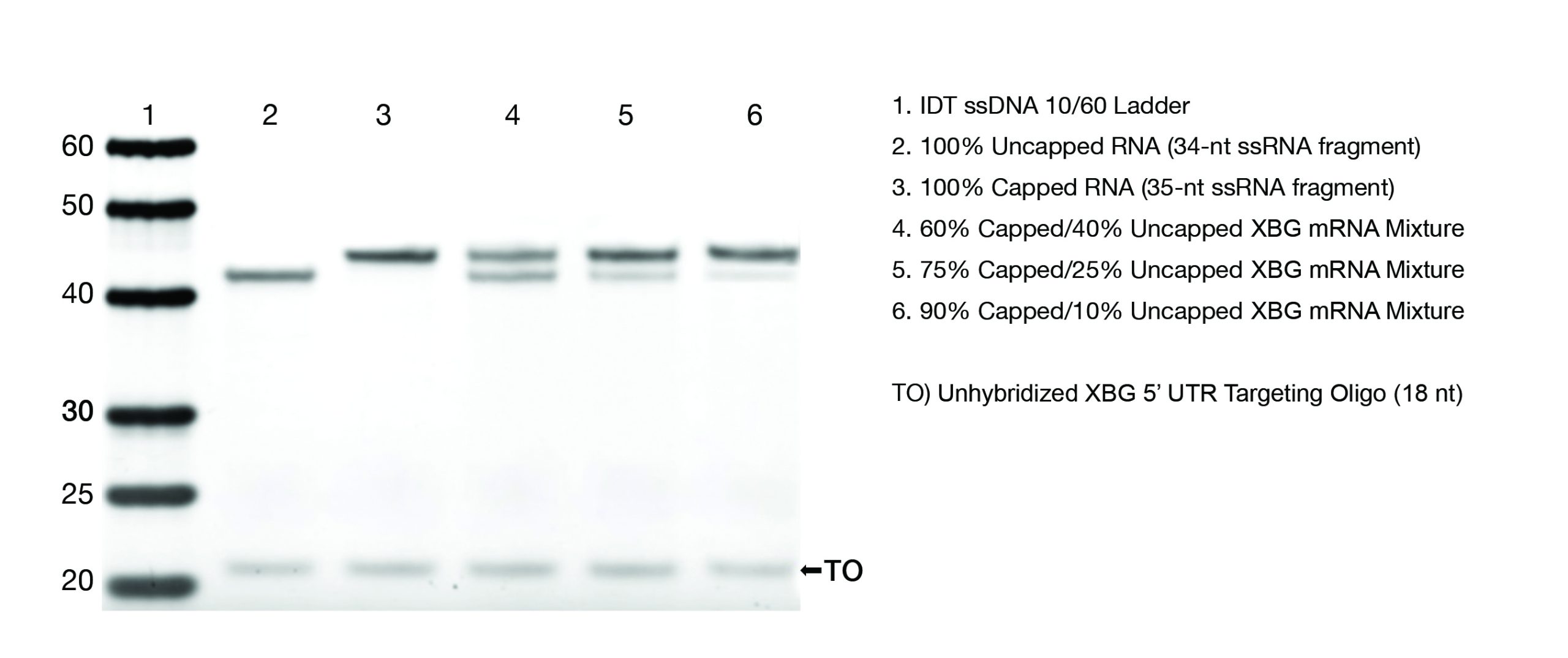
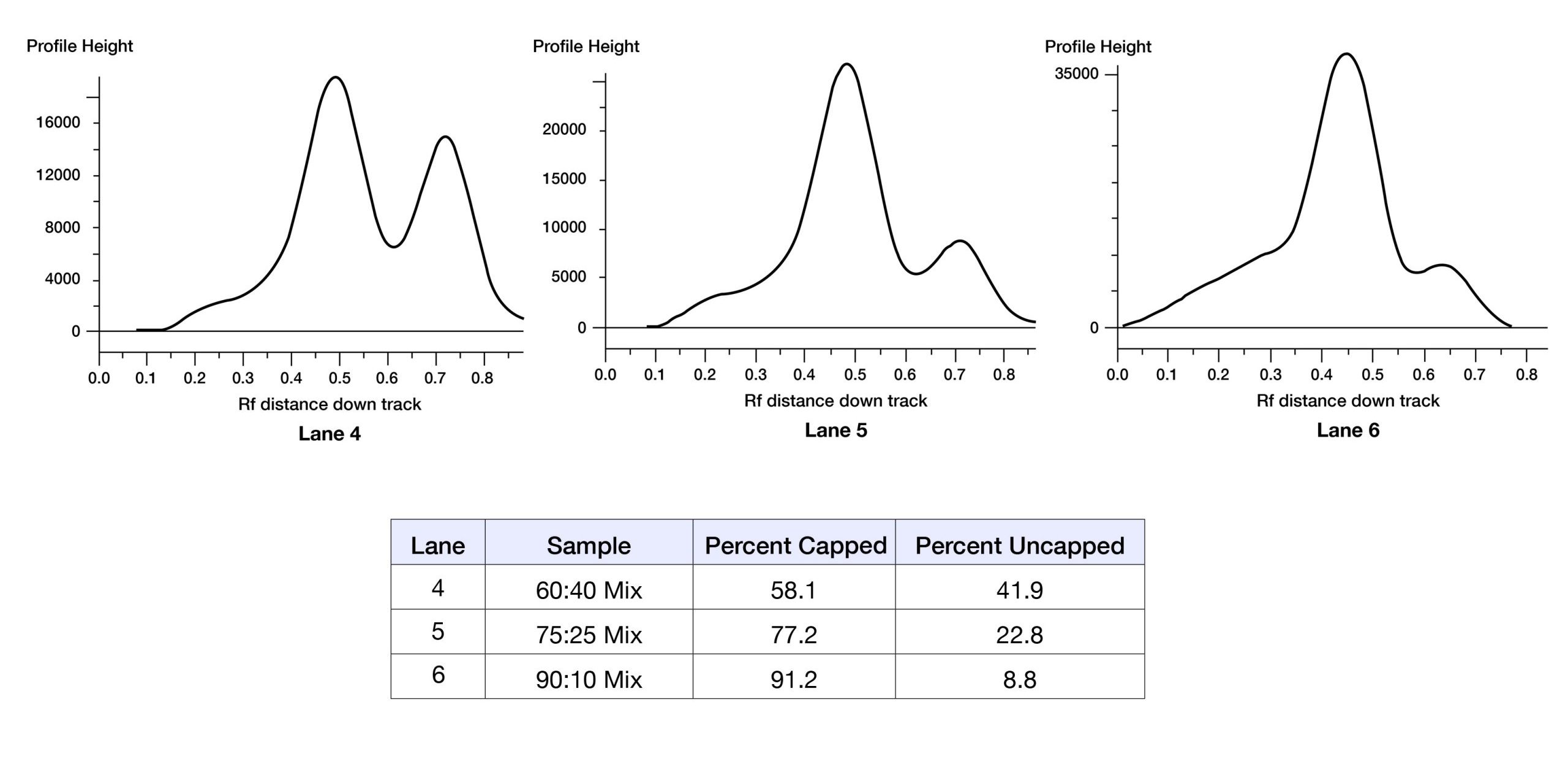
Mixtures of capped and uncapped mRNA were assayed using the EZ-QC™ XBG mRNA Capping Efficiency Assay Kit and resolved on a polyacrylamide gel (Figure 1A). The Targeting Oligonucleotide facilitates cutting the mRNA at a single, repeatable location allowing for greater confidence in determining the percentage of capped and uncapped content of the assayed samples. The percent capped and uncapped mRNA in a mixture are calculated with a simple readout from any gel imaging system (Figure 1B).
Figure 1A. Capped and uncapped 5’-end fragments are efficiently resolved by PAGE allowing for capping efficiency analysis with standard lab equipment.
Figure 1B. Densitometric data from lanes 4, 5, and 6 from the above PAGE gel using a Syngene® G:Box Gel Documentation System. The percent capped and uncapped mRNA in each mixture are calculated using a simple readout.
Materials Supplied:
Important Store at -20°C in a freezer without a defrost cycle. Do not store at –70°C.
EZ-QC™ XBG mRNA Capping Efficiency Assay Kit Contents (10 reactions)
Sufficient for 10 experimental and 10 control reactions. |
Kit Component |
Reagent Volume |
EZ-QC™ RNase H
in 50% glycerol, 50 mM Tris-HCl, pH 7.5, 100 mM NaCl, 1 mM dithiothreitol (DTT), 0.1 mM EDTA and 0.1% Triton® X-100. |
23 μl |
10X EZ-QC™ RNase H Reaction Buffer
0.2 M Tris-acetate, pH 7.9, 0.5 M potassium acetate, 0.1 M magnesium acetate and 0.01 M DTT. |
23 μl |
ScriptGuard™ RNase Inhibitor, 40 U/μl
in 50% glycerol, 50 mM Tris-HCl, pH 7.5, 100 mM NaCl, 10 mM DTT, 0.1 mM EDTA and 0.1% Triton X-100. |
12 μl |
XBG 5' UTR Targeting Oligo, 5 μM (5 pmoles/μl)
in RNase-Free Water. |
28 μl |
XBG 5' UTR Control Mix, 2.5 μM (2.5 pmoles/μl)
an 80% capped / 20% uncapped RNA Mix in RNase-Free Water. |
6 μl |
Stop/Loading Buffer
95% formamide, 10 mM EDTA, pH 7.5, 0.01% Bromophenol Blue and 0.01% Xylene Cyanol. |
230 μl |
RNase-Free Water |
575 μl |
Materials Required, but not Supplied
- Purified capped mRNA/RNA
- Materials for polyacrylamide gel electrophoresis
- Materials for polyacrylamide gel visualization, imaging and quantification
- Optional: molecular weight marker (e.g., ssDNA 10/60 Ladder [IDT])
Terms & Conditions: The Product listed is currently offered by CELLSCRIPT™ for research use only under the defined Terms and Conditions.
FAQs: For answers to Frequently Asked Questions about our products, visit the FAQ library.
Still have questions? Our mRNA experts are here to help.
Troubleshooting Guide:
Symptom |
Solution |
More than two bands present in the capped/uncapped region of the gel |
The Targeting Oligo hybridized in multiple locations.
- Run the capped and uncapped experimental samples alongside a kit control reaction to identify the experimental bands of interest, then quantitate only the bands of interest.
Note: the released 5'-end fragments from the experimental mRNAs may not comigrate with those of the control reaction depending on the sequence of the experimental mRNAs. |
Targeting Oligo migrates within the capped/uncapped excised fragment range.
- Run the capped and uncapped experimental samples alongside a lane containing the XBG 5' UTR Targeting Oligo-only to identify the experimental bands of interest, then quantitate only the bands of interest.
|
Faint capped/uncapped bands |
mRNA 5'-end secondary structure is preventing efficient hybridization of the Targeting Oligo.
- Preanneal the mRNA and Targeting Oligo, via mixing, heating and cooling, before adding the rest of the reaction components.
|
A molar excess of Targeting Oligo was not used in the reaction. Unhybridized Targeting Oligo should be visible on the gel.
- Recheck experimental stoichiometry.
- Add more Targeting Oligo to the reaction.
|
Load more completed reaction sample per well. |
Increase the reaction incubation time to 60 minutes. |
Near full lane of many bands |
RNase contamination.
|
XBG 5' UTR Targeting Oligo is degrading.
- Run a sample of the XBG 5' UTR Targeting Oligo-only on a gel to assay for integrity.
|
Fuzzy bands |
Problems with the PAGE system (e.g., gel not totally polymerized, gel ran too hot, urea wasn't blown out of the wells just prior to sample loading, buffer issue).
|
Capped and uncapped bands unresolved |
A <20% polyacrylamide gel was used.
- Rerun the gel using 20% polyacrylamide. Commercially-available pre-poured 15% gels most often do not resolve the bands adequately.
|