dsRNA Removal

dsRNA Removal
Why your mRNA is underperforming —
and what to do about it.
Min-Immune™ Gold dsRNA Removal Kit
Up to 55X
higher luciferase reporter signal vs. untreated canonical UTP mRNA
Average ~24X across all conditions tested
Minimal Yield Loss
vs. traditional chromatographic methods
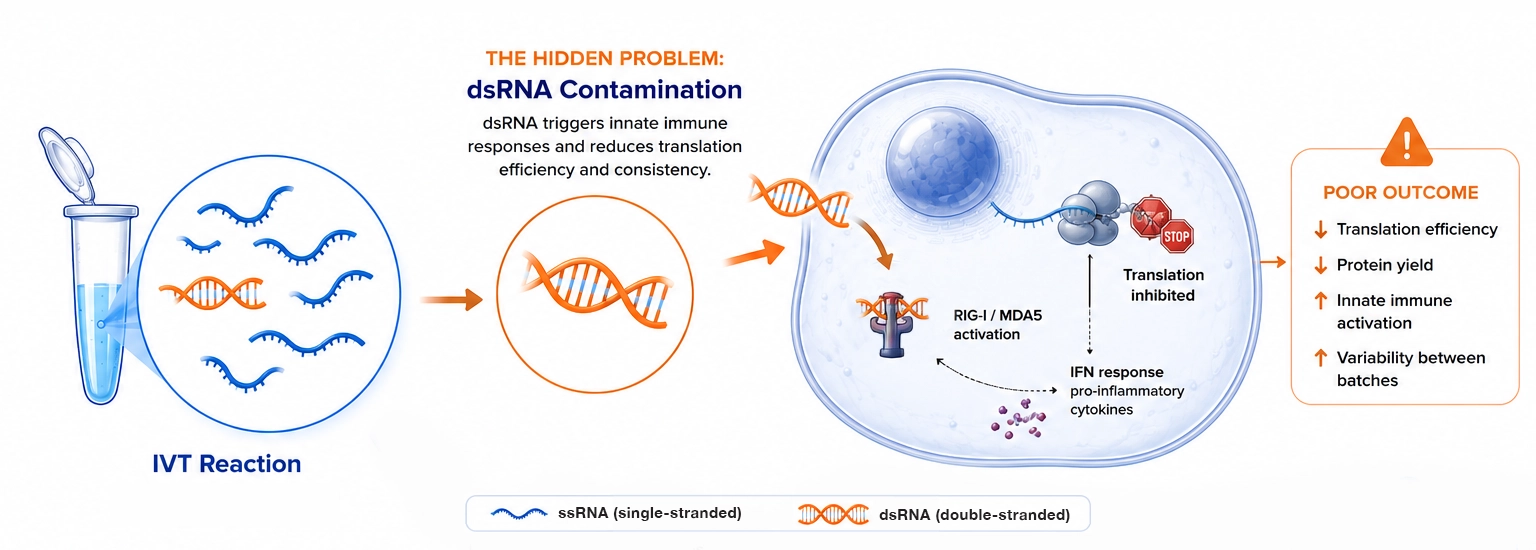
The Hidden Problem
dsRNA: the IVT byproduct nobody asked for
Every T7 in vitro transcription reaction generates double-stranded RNA as a byproduct — through snap-back of single-stranded transcript ends, antisense synthesis from polymerase runoff and abortive transcripts priming secondary reactions. Canonical or modified nucleotides, it doesn’t matter: none of the chemistry that reduces immune activation downstream does anything to stop dsRNA from forming during transcription itself.
dsRNA is a potent activator of innate immune pattern recognition receptors. Cells evolved these sensors to detect viral infection — and dsRNA is exactly what a replicating virus looks like to a cell, whether it came from a pathogen or your IVT reaction.
Once triggered, these sensors launch an interferon response that suppresses translation and ramps up inflammatory signaling at the same time. In practice, that looks like expression that’s lower than it should be, results that don’t reproduce cleanly between IVT batches and, at higher contamination levels, visible cytotoxicity. Most people troubleshoot transfection reagent, cell health and construct design long before they think to check dsRNA content.
dsRNA is potent at remarkably low concentrations. Residual dsRNA well below what standard purification typically achieves can still engage antiviral pathways — underscoring that even immune-evading nucleotide chemistry doesn’t make a sample’s dsRNA content irrelevant.
Does this sound familiar?
For Modified Nucleotide Users
You’re already using modified nucleotides — here’s what they still leave on the table
N1-methyl-pseudouridine and pseudouridine substitution reduce immune activation through one pathway — but they don’t touch the dsRNA-driven pathway, because dsRNA accumulates regardless of which nucleotide you use. The two approaches are additive, not redundant.
What N1meΨ and Ψ don’t fix on their own
Ψ-containing mRNA treated with enzymatic dsRNA removal showed up to 4.6-fold higher luciferase reporter signal than untreated Ψ mRNA, depending on cell type and timepoint. N1meΨ mRNA gained roughly 1.8-fold on top of what the modification already provides. This pattern — larger gains from dsRNA removal in less-modified mRNA, smaller gains as modification increases — isn’t unique to our data. Using a different purification method, Karikó and colleagues reported the same shape in 2011: the largest translation increases in unmodified mRNA, and progressively smaller increases as nucleoside modification increased (1). The two aren’t doing the same job: modified nucleosides make the RNA harder for nucleoside-sensing pathways to flag as foreign, but they don’t do much about the separate set of receptors that respond to double-stranded structure. Swap in N1meΨ and those dsRNA-specific sensors are still sitting there, waiting for dsRNA that’s still in the sample.
Across eight sensor genes tested, the primary dsRNA sensors — RIG-I, TLR3, MDA5 and OAS1 — dropped by 81–86% after enzymatic removal. That held regardless of which nucleoside was used going in.
N1meΨ: ~1.8X
For Self-Amplifying RNA Researchers
For saRNA, dsRNA removal isn’t optional
Self-amplifying RNA retains the viral replicase needed for intracellular replication. Modified nucleotides — the immune-evasion strategy available to standard mRNA — generally impair that replicase and typically are not used. For saRNA, enzymatic dsRNA removal isn’t one option among several — it’s the only practical route to a preparation that actually works
The Problem
A 9-kb VEE-based saRNA encoding GFP, transfected untreated into THP-1 monocytes, triggered strong upregulation of dsRNA sensors and cytokines — and showed very weak GFP expression. In HEK293 cells, untreated saRNA produced visible cytotoxicity and disrupted cell morphology alongside GFP expression.
The Result
dsRNA removal restored immune gene expression to near-baseline levels and improved functional performance — enhanced GFP expression with preserved cell viability in HEK293 and restored expression in THP-1 monocytes. Both 15-minute and 60-minute treatments were equally effective.
The Solution
What good dsRNA removal looks like
Enzymatic removal using RNase III selectively degrades dsRNA with minimal loss of single-stranded RNA — a fundamentally different approach from chromatographic methods, which trade yield and cost for purity. The Min-Immune™ Gold dsRNA Removal Kit is CELLSCRIPT’s enzymatic solution, validated across canonical, Ψ and N1meΨ mRNA, and across standard mRNA and saRNA.
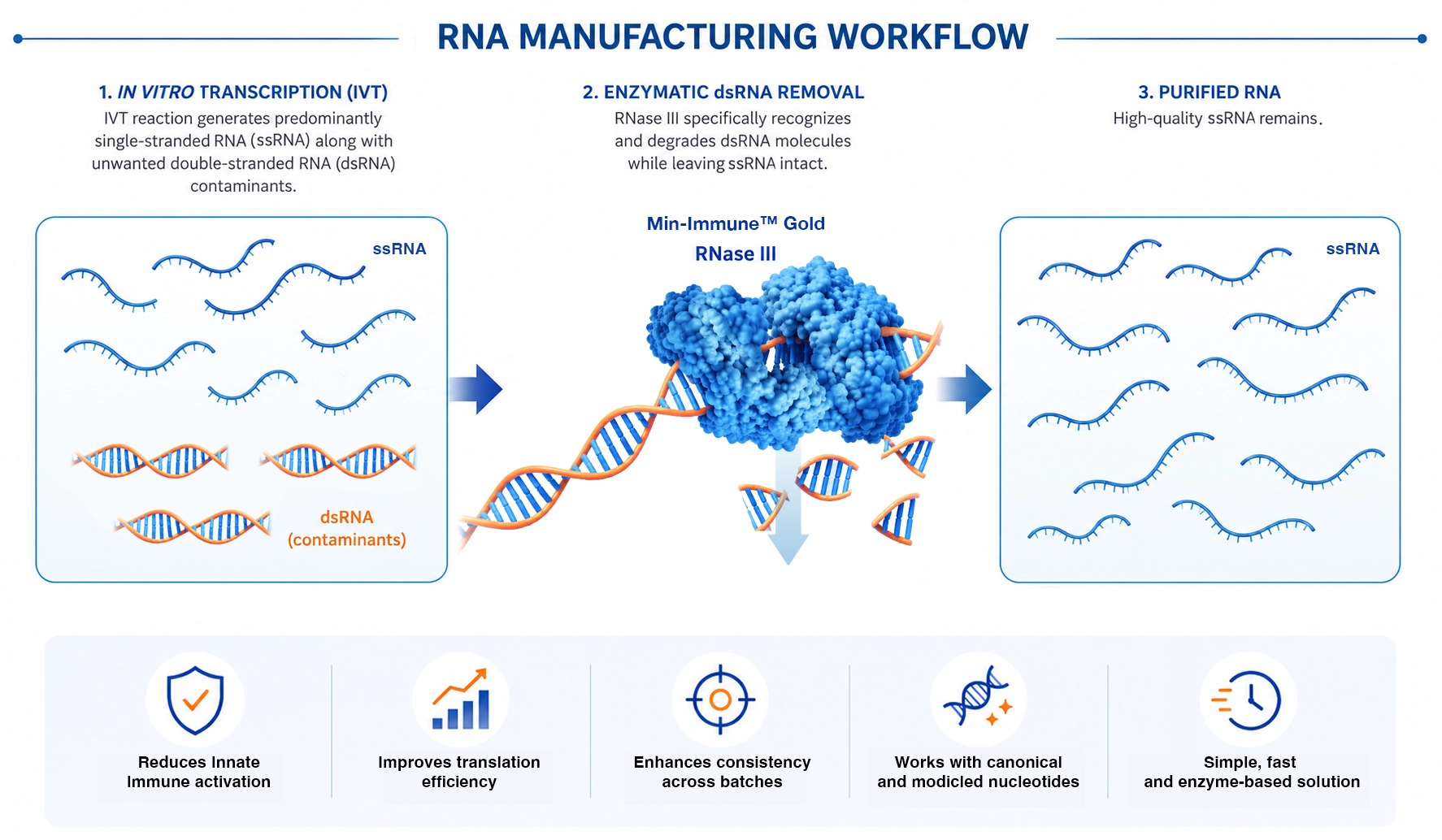
Min-Immune™ Gold dsRNA Removal Kit
Enzymatic dsRNA removal using RNase III, reducing sample dsRNA content to below the limit of quantification (<0.005%) while retaining single-stranded RNA yield. Suitable for most samples regardless of length, end modifications, or NTP content — including canonical, Ψ, N1meΨ and 5mC-modified mRNA, as well as self-amplifying RNA. Available as a standalone kit or as a built-in module in the T7 mScript™ Complete Standard mRNA Production System.
nucleotide
HPLC
required
years
| Your situation | What this means | Where to start |
|---|---|---|
| I don’t know if dsRNA is my problem | Poor translation, inconsistent results or unexpected immune activation are the classic symptoms — and most researchers troubleshoot everything else first | Read the mechanism above |
| I already use N1meΨ or Ψ mRNA | Modified nucleotides don’t eliminate dsRNA. Enzymatic removal adds up to 4.6X more expression on top, depending on which nucleoside you’re using | See the additive data |
| I work with self-amplifying RNA | Modified nucleotides impair the viral replicase and typically aren’t used. Enzymatic dsRNA removal is the only practical path | See App Note 006 |
| I’m evaluating dsRNA removal options | Chromatographic methods (HPLC, cellulose, dsRNA affinity, low pH oligo-dT) trade yield and cost for purity. Enzymatic removal achieves comparable or greater dsRNA reduction with no yield loss | View product specs |
| I want this built into my IVT workflow | The Min-Immune™ Gold dsRNA Removal Kit is included as a module in the T7 mScript™ Complete mRNA Production Systems — IVT, capping, tailing and dsRNA removal in one kit | See Complete Systems |
Resources
The full data
Primary data behind every claim on this page — for researchers who want to evaluate the evidence directly.
App Note 006: Min-Immune™ Gold-Mediated dsRNA Depletion Restores Expression and Viability of VEE Self-Amplifying RNA
Meis & Khanna, CELLSCRIPT™ 2026. Full saRNA dataset — GFP expression, cell viability and 12-gene immune sensor panel.
Download PDF →Enzymatic Elimination of dsRNA Byproducts Enhances Translation and Reduces Innate Immune Activation of mRNA
Full luciferase expression and 8-gene immune sensor data across canonical, Ψ and N1meΨ mRNA in three cell types.
Download PDF →High-Efficiency mRNA Synthesis and Ultra-Low Immunogenicity with T7 mScript™ Complete Systems
Meis, Lahr, Meis, Bradtke & Khanna, CELLSCRIPT™. Luciferase expression and EZ-QC™ quality data for canonical and N1meΨ mRNA, with and without dsRNA removal.
Download PDF →Enzymatic Purification Strategies to Eliminate dsRNA
Gerhardt, Parker, Lahr, Meis & Meis, CELLSCRIPT™. Combined mRNA and saRNA dataset with purification method comparison.
Download PDF →Why your mRNA is underperforming: the dsRNA problem most workflows aren’t solving
Why dsRNA contamination, not nucleotide chemistry alone, is often the reason mRNA underperforms — and what removing it actually changes.
Read post →1 Karikó K, Muramatsu H, Ludwig J, Weissman D. (2011) Generating the optimal mRNA for therapy: HPLC purification eliminates immune activation and improves translation of nucleoside-modified, protein-encoding mRNA. Nucleic Acids Res. 39(21):e142.
Stop troubleshooting the wrong problem.
The Min-Immune™ Gold kit: enzymatic dsRNA removal to <0.005% LLOQ, with no loss of RNA yield. Compatible with canonical and modified-nucleotide mRNA and the only viable immunogenicity solution for self-amplifying RNA.
